A Practical Guide to AI Search Engine optimization
AI search engine optimization is about making sure that when someone asks an AI like ChatGPT or Gemini a question, your brand shows up in the answer—and in a positive light. This is a new discipline, distinct from traditional SEO. We’re no longer just chasing clicks; we’re working to shape the conversation itself, turning AI into a powerful marketing channel.
Understanding the New Search Landscape
The old search routine is fading. For a growing number of people, that familiar page of ten blue links is no longer the final destination. They’re turning to AI for a direct, synthesized answer, creating a new digital frontier that requires a completely different playbook.
For anyone with a brand to protect or promote, this isn't some far-off trend. It's happening right now. The goal of AI search engine optimization is to take control of how your brand is being represented on this new conversational layer of the web. It's about being proactive, not reactive.
From Clicks to Conversations
We've spent decades focused on climbing the search engine results pages (SERPs). The entire strategy was built around earning that click. While that still matters, AI search adds a new, crucial layer. Now, the AI's answer is often the final product the user sees.
This fundamentally changes the game for marketers in three key ways:
- Visibility becomes narrative. You're no longer just a link in a list. Your brand is now part of a story being told by an AI.
- Trust is everything. AI models build their knowledge from a vast web of public sources. Your reputation across those sources directly feeds into how you’re portrayed.
- Measurement must adapt. We're moving beyond clicks and traffic. The new KPIs are metrics like visibility share (how often are you mentioned vs. the competition?) and sentiment score.
This graphic really captures how the user's journey has evolved from the classic search we all know to the direct answers AI provides.
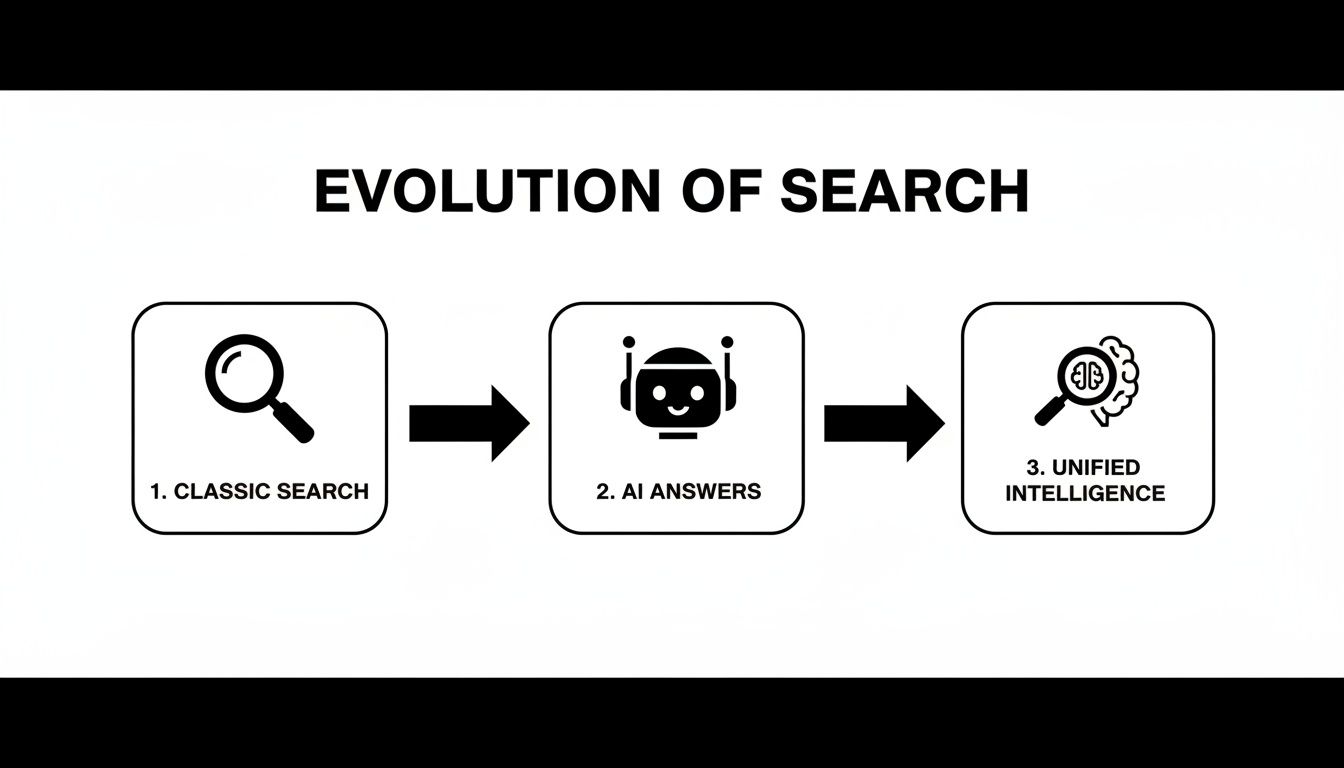
As you can see, the classic model involves the user doing the work of sifting through sources. With AI, the goal is a single, unified answer, making it absolutely critical for your brand to be included from the get-go.
The Growing Impact of AI-Driven Traffic
This isn't just a theory; it's already showing up in the data. Recent studies are staggering, revealing that referral traffic from large language models (LLMs) shot up by 527% year over year. That’s a jump from 17,000 to 107,000 sessions.
Some sites are even reporting that over 1% of their total traffic is now coming straight from platforms like ChatGPT, Perplexity, and Copilot. You can dig deeper into these AI SEO statistics and their impact to see the full picture.
For marketers, this means a growing chunk of your audience is finding you (or not finding you) through an AI. If you're not in the AI's answer, you might as well be invisible for that search.
Getting ahead of this means you must be proactive. You need to audit your current AI visibility, identify which sources the models are learning from, and start creating content that AI can easily digest and trust. It's a new frontier, and tools like PromptPosition are emerging to provide the analytics needed to navigate it.
How to Audit Your Brand's AI Visibility
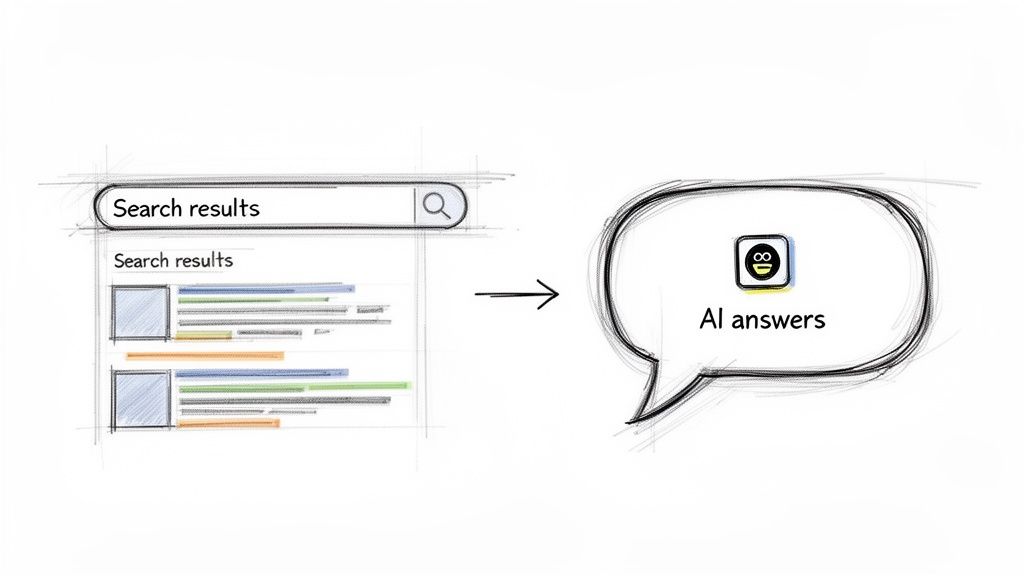
Before you can shape how AI talks about your brand, you need to know what it’s already saying. This is where an AI visibility audit comes in—it’s the essential first step in any practical AI search engine optimization strategy.
Think of it as seeing your brand through the eyes of models like ChatGPT, Gemini, and Claude. This isn't just a quick check-in; this audit establishes your baseline, the stake in the ground you’ll use to measure all future progress. Without it, you’re flying blind. Your goal is to uncover how often your brand gets mentioned, in what context, and whether the sentiment is positive, negative, or simply inaccurate.
Start with Foundational Brand Prompts
First, let's see if the AI even knows who you are. This is the ground floor of your audit—asking simple, direct questions about your own brand. You can't tackle complex competitive queries until you know the basics are covered.
Grab a simple spreadsheet. Fire up a few major LLMs and ask them the same questions, copying their answers verbatim. This is your starting point for action.
- Basic Identity:
What is [Your Brand Name]? - Product/Service Description:
What does [Your Product/Service] do? - Target Audience:
Who is [Your Brand Name] for? - Key Features:
What are the main features of [Your Product/Service]?
These simple prompts are incredibly revealing. You might find outdated information, see your brand confused with a similarly named company, or get the dreaded "I don't have enough information about that." Any of these are red flags that demand immediate action.
Test Competitive and Comparative Queries
Now that you have a baseline, it's time to see how you measure up against the competition. This is where the audit gets really interesting because it reveals your position in the market. Users constantly ask AI to compare products or recommend the "best" option, and you need to be part of that conversation.
Get ready to dig into prompts like these:
- Direct Comparisons:
Compare [Your Brand] vs. [Competitor A].This is a head-to-head matchup. How does the AI frame your features, pricing, and overall reputation against your biggest rivals? - Best-in-Class Queries:
What is the best software for [Your Use Case]?This is the money question. If you’re not showing up in the top recommendations for your core business, you have a critical visibility gap to fix. - Alternative Searches:
What are some alternatives to [Competitor A]?Being mentioned here is a massive opportunity. It means you’re catching potential customers right when they’re looking for a new solution.
The real gold is in the patterns. If one AI model consistently omits you from "best of" lists or always frames a competitor more favorably, you've just uncovered a major vulnerability in your AI visibility.
As you run these queries, don't just look for a mention. You need to analyze the sentiment—is it positive or negative? And what key attributes does the AI highlight? These details tell you how the AI perceives your brand, not just if it does.
Establish Your Core Metrics and KPIs
A one-time manual audit is a great start, but to make this a sustainable strategy, you need to track your performance over time. This means turning your initial findings into Key Performance Indicators (KPIs) that you can monitor consistently. You can do this by hand, but it gets tedious fast. This is where specialized tools truly become essential.
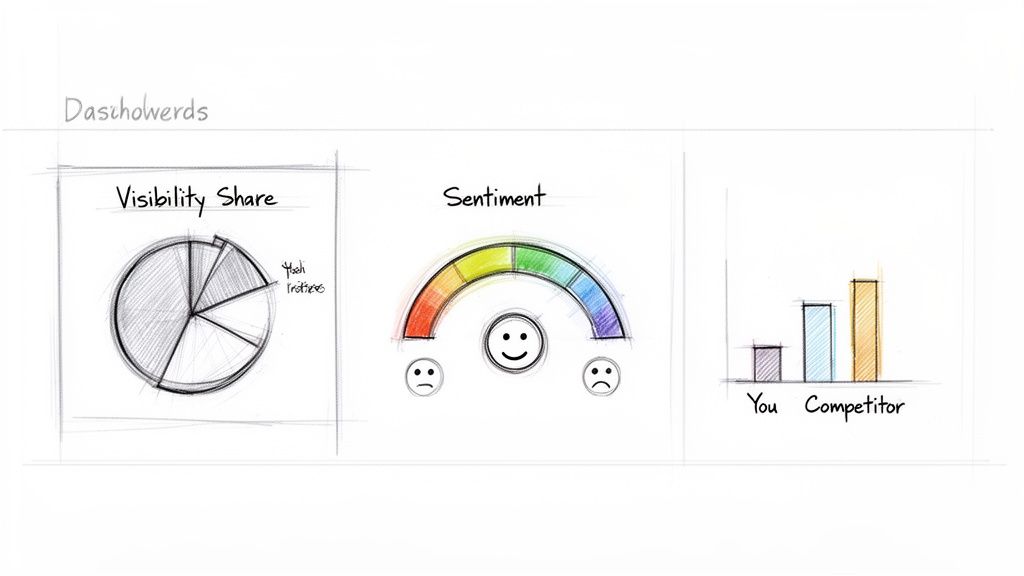
For instance, at promptposition, our dashboard is built to track these metrics automatically.
Visualizing your performance against competitors makes it dead simple to see if your efforts are paying off. Here are the core metrics you absolutely must be tracking:
- Visibility Share: What percentage of relevant AI answers mention your brand versus the competition?
- Sentiment Score: On a scale, are the mentions of your brand generally positive, neutral, or negative?
- Source Mentions: Which specific articles, reviews, and websites is the AI citing when it talks about you? This is key for your content strategy.
- Accuracy Rate: How much of the information the AI shares about your brand is actually correct?
By running this audit and setting up your KPIs, you’re no longer guessing. You have a data-backed strategy and a clear benchmark to prove your work is making a difference. Now you’re ready to start influencing the sources that shape the AI’s understanding of your brand.
Where Does an AI Get Its Information About You?
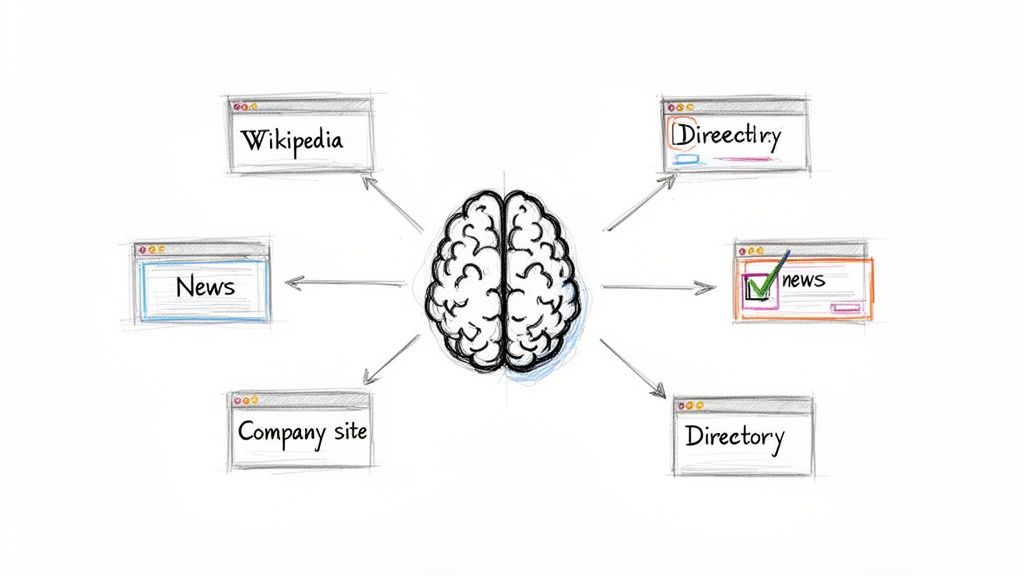
Large language models don't just invent facts. Their understanding of your brand is a mosaic, pieced together from the massive library of public information they've been trained on. This means any real AI search optimization has to start by deconstructing that mosaic to see which pieces actually matter.
The answers you uncovered during your brand audit didn't appear from thin air. An AI synthesized them from articles, directories, forums, and company websites it considers authoritative. Your job now is to become a digital detective and trace the AI’s logic back to its roots. This is the only way to get ahead of the curve and start shaping AI outputs instead of just reacting to them.
When you see a flat-out incorrect answer about your company, the first question shouldn't be, "How do I fix the AI?" It should be, "Where did the AI learn this?"
Pinpointing the AI's Source of Truth
To influence an AI, you first have to figure out what it's already reading. Sometimes, this is easy. LLMs will often cite their sources, giving you a direct breadcrumb trail to follow. If a model mentions a specific article when describing your product, that article immediately becomes a high-priority target.
But it's not always so obvious. You often have to do a bit of sleuthing by looking for patterns in the AI's language. Does its description of your company sound suspiciously like your old Wikipedia page or an outdated Crunchbase profile? That's your clue.
Here’s a practical action plan to start mapping these sources:
- Follow the Citations: Pay close attention to any links or references the AI provides. These are your most direct leads and the lowest-hanging fruit.
- Search for Verbatim Phrases: Copy a unique sentence from the AI's answer and drop it into Google. This can often lead you straight to the original article or webpage.
- Audit High-Authority Platforms: Prioritize checking your brand's presence on universally trusted domains. AI models lean heavily on these as their foundational knowledge sources.
Your goal isn't just to find a single source. It's to map the entire "knowledge graph" an AI has built around your brand. This map will show you which nodes are strong and positive, and which ones are weak or spreading misinformation.
Once you have this map, the guesswork is over. You can build a targeted strategy, focusing your finite resources on the sources that have the most influence.
A Framework for Influencing the Source Material
With your list of influential sources in hand, it's time to act. This is where you shift from analysis to direct influence—correcting the bad info and amplifying the good. Think of it like tending a garden: you need to pull the weeds (misinformation) and water the flowers (positive, accurate content).
This work generally falls into two buckets: owned and earned media.
Correcting and Updating Your Foundational Footprint
So many of the foundational knowledge platforms are either user-editable or rely on company-submitted data. These are your quick wins and the first thing you should tackle.
- Wikipedia: Is your company's page accurate? If not, follow Wikipedia's guidelines to suggest edits or correct factual errors. A clean, well-referenced page is an incredibly powerful signal for any LLM.
- Crunchbase and Similar Sites: For tech companies, platforms like Crunchbase are a primary source of truth for funding, leadership, and company size. Make sure your profile is claimed and meticulously updated.
- Industry-Specific Review Sites: Whether it's G2 for software or TripAdvisor for travel, these platforms are treasure troves of sentiment and feature descriptions that AIs readily consume.
Earning Positive and Factual Coverage
Beyond directories, AIs learn from news articles, press releases, and high-quality blog posts. Influencing this sphere requires a more proactive PR and content strategy. The goal here is to build a strong network of positive, factual 'brand signals' that LLMs will consistently use as a reference.
For example, let's say an AI incorrectly claims your product lacks a key feature. A targeted press release announcing that feature's launch or a detailed blog post explaining how it works can directly counteract the misinformation.
Over time, as the AI’s knowledge base gets updated, it will begin to favor the newer, more authoritative content. Using a tool like promptposition lets you actually see this happen, tracking when new, positive sources start appearing in AI-generated answers after a PR push. This creates a powerful feedback loop, showing you exactly which of your efforts are moving the needle.
So, how do you actually write content that an AI will not only understand, but also trust and feature in its answers?
It's a bit different than the traditional SEO playbook we've all gotten used to. While writing for an algorithm isn't new, writing for a learning algorithm requires a fresh perspective. The name of the game is clarity.
Think about it this way: LLMs aren't casually reading your blog post over a cup of coffee. They're parsing it—systematically breaking it down into structured information to check for facts, authority, and relevance. If your key points are buried in dense paragraphs or your language is vague, the AI will likely skip over you for a source that’s easier to make sense of.
Your job is to make it incredibly easy for the model to grasp your meaning with absolute confidence.
Facts Over Fluff: Speak the AI’s Language
Let’s be honest, those fluffy marketing claims we’ve all written don't fly with AI. Phrases like "best-in-class" or "next-generation" are essentially meaningless to a model that’s hunting for verifiable facts.
You have to anchor your statements in real, measurable data. Instead of saying your software is "fast and efficient," get specific. Say it "processes 10,000 records in under 60 seconds." That's the kind of precise, factual language LLMs are built to understand and use.
This logic extends to how you structure your content, too. AI models lean heavily on HTML elements to figure out the hierarchy of information on a page.
- Headings are your signposts. H2s and H3s act like chapter titles for the AI, clearly marking where one topic ends and the next begins. Ditch vague headings like "More Info" and opt for descriptive ones like "Technical Specifications and Compatibility."
- Lists and tables are your friends. Bullet points, numbered steps, and tables are fantastic for breaking down complex ideas into clean, reusable chunks. They're especially powerful for answering "how-to" questions or comparing product features.
- Q&A formats are a direct line. Structuring content in a direct question-and-answer format perfectly mirrors how people actually query AI assistants. It makes your content a prime candidate for being lifted directly into a generated response.
Here's a key takeaway: An AI is far more likely to trust and cite content that is well-organized and unambiguous. Walls of text just blur your ideas together, making it tough for the model to pull out usable facts. Clean structure is like pre-packaging your content for AI consumption.
Optimizing for AI isn't just a minor tweak to your existing SEO strategy; it requires a fundamental shift in how you think about content creation. Where traditional SEO often prioritizes keyword density and backlink-friendly formats, AI SEO demands a move toward structured, factual, and context-rich information.
The table below breaks down some of the key differences in approach.
Traditional SEO Content vs. AI SEO Content
| Attribute | Traditional SEO Focus | AI SEO Focus |
|---|---|---|
| Primary Goal | Rank for specific keywords on a SERP. | Become a trusted source for AI-generated answers. |
| Language Style | Often creative, persuasive, and keyword-rich. | Factual, direct, and unambiguous. Data over claims. |
| Content Structure | Long-form articles, blog posts. | Highly structured: Q&As, lists, tables, short paragraphs. |
| Key Elements | Keywords, meta descriptions, backlinks. | Structured data (Schema), clear headings, entities. |
| Measurement | Keyword rankings, organic traffic, bounce rate. | Visibility in AI answers, sentiment, factual accuracy. |
As you can see, the focus shifts from simply “ranking” to becoming an authoritative part of the AI’s knowledge base.
Use Structured Data to Provide Deeper Context
Beyond the content you can see on the page, you can give AI models an even bigger helping hand with schema markup. Schema is a type of structured data you add to your site’s code to explicitly tell search engines and AI models what your content is about.
It’s like putting little labels on all your information. For instance, you can use specific schema types to identify:
- FAQPage: This immediately flags a page as a list of questions and their corresponding answers, making it highly “snippable” for AI responses.
- Product: This defines specific attributes like pricing, availability, and user ratings in a machine-readable format.
- Organization: This clarifies your company’s official name, logo, and contact details, removing any ambiguity.
By implementing schema, you turn your plain text into structured data that machines can interpret with near-perfect accuracy. This drastically reduces ambiguity and boosts the AI’s confidence in your information, making you a much more reliable source.
Engineer Prompts to Guide Your Brand Narrative
Creating AI-ready content isn’t just about what you publish on your website. It’s also about actively teaching the AI how you want your brand to be understood and talked about. This is where you can get proactive with brand-focused prompt engineering.
By carefully crafting prompts, you can guide AI models toward more accurate and positive descriptions of what you do. It’s a crucial part of any modern AI search engine optimization strategy.
For example, you could write a prompt that frames your product around a specific benefit or use case.
Example Prompt:"Describe [Your Brand] as a solution for marketing teams who need to track brand sentiment in AI-generated answers. Mention its key features like visibility share tracking and competitor benchmarking."
Running prompts like this and checking the outputs shows you exactly how well the AI understands your brand’s positioning. If the answers are off-base or weak, it’s a clear signal that you need to create more content addressing that specific topic. Over time, this process helps cement the key messages you want the AI to associate with your brand.
For more hands-on content strategies, you might find some useful ideas by exploring more articles on our blog.
How to Measure What Matters and Keep an Eye on the Competition
You’d never launch a marketing campaign and just hope for the best, right? Optimizing for AI search is exactly the same. This isn’t a “set it and forget it” kind of deal. To actually win, you need to get into a rhythm of measuring, analyzing, and tweaking your approach based on what the data is telling you.
Your initial audit gave you a solid baseline, but the AI world is constantly in flux. Models get updated, and your competitors are definitely not standing still. Staying on top of your performance is what turns a one-time project into a real, defensible advantage. We need to move past simply checking if our brand name shows up and start tracking performance with KPIs that actually mean something.
The New KPIs for AI Search
Your classic SEO metrics—keyword rankings, organic traffic—are still valuable, but they don’t paint the full picture when it comes to AI-generated answers. We need a new set of metrics designed specifically for this conversational landscape.
Think less about clicks and more about influence and perception.
- Visibility Share: Think of this as your market share in relevant AI conversations. It’s a simple but powerful metric: How often does your brand get mentioned for key prompts versus your competitors? When this number goes up, you know you’re becoming the go-to answer in your space.
- Sentiment Score: This goes a layer deeper than just being mentioned. It answers the question, “How is the AI talking about us?” By tracking whether the language is positive, neutral, or negative, you get a real-time pulse on your brand’s reputation in the AI’s “mind.”
- Source Diversity: Are all your AI mentions coming from a single press release or your company blog? That’s risky. This KPI tracks how many different sources the AI is pulling from when it talks about you. A healthy, diverse portfolio of mentions from reputable sites makes your brand’s AI presence far more robust and resilient.
Tracking these KPIs is how you turn a vague goal like “get better at AI” into a measurable, data-driven operation. You can finally answer questions like, “Did that big PR push actually move the needle on our positive sentiment?” or “Are we losing ground to that new startup?”
The Advantage of Competitive Benchmarking
Knowing your own stats is great, but it’s only half the story. The real strategic gold is in benchmarking yourself against everyone else. You’ve got to know where your rivals are winning, where they’re vulnerable, and where you can carve out an advantage.
In the world of AI search, competitive analysis is all about finding the gaps. Let’s say a competitor is consistently named in answers for “best software for project management,” but your brand is nowhere to be seen. That’s not just an observation; it’s a high-priority target.
Here’s how to start your competitive analysis:
- Who are my real AI competitors? You might be surprised. They aren’t always your usual suspects from traditional search. A small startup with a killer Wikipedia page could be eating your lunch in AI answers.
- What does their sentiment look like? If a competitor has high visibility but the sentiment is consistently negative, that’s a massive opportunity. You can swoop in and position your brand as the more trusted, reliable choice.
- What sources are propping them up? Look at the sources the AI cites when mentioning your competitors. If they’re getting a ton of love from a specific industry blog or review site, that’s a flashing neon sign for your own content and PR teams.
Turning All This Data into a Winning Strategy
Data is useless if you don’t do anything with it. The final, crucial step is to use these performance metrics and competitive insights to constantly refine your game plan. This creates a powerful feedback loop of continuous improvement.
For example, you might pop into your dashboard on a tool like PromptPosition and see a competitor’s visibility share shot up last month. You dig a little deeper and discover the AI is now citing a glowing review they just landed on a major tech blog.
That’s an actionable insight. Your next move is crystal clear: get your own product in front of that same publication or similar ones to build your own authoritative signals. You can see how this all comes together by exploring the tools over at promptposition.
This constant cycle—measure, benchmark, and act—is the absolute core of doing AI search optimization right. It ensures you’re not just reacting to the landscape but actively shaping how your brand shows up in the future of search.
Your AI SEO Questions, Answered
As we all wrap our heads around this new frontier, questions are bound to pop up. The old SEO playbook we’ve all been using for years doesn’t quite apply here, and it’s completely normal to feel a bit lost. Let’s clear the air and tackle some of the most common questions I hear from marketers diving into AI search engine optimization.
My goal here is to cut through the noise and give you the clarity to move forward with confidence. Getting these core concepts down is the first real step to building a brand that shows up—and shines—in the age of AI-generated answers.
What’s The Real Difference Between Traditional SEO And AI SEO?
For years, traditional SEO has been a race to the top of Google’s search results. It’s all about ranking web pages for specific keywords to drive clicks and get that precious organic traffic to your site. You win when someone clicks your link.
AI SEO is a totally different game. It’s less about clicks and more about influence. The goal is to make sure your brand is mentioned—accurately and positively—right inside the direct answers generated by models like ChatGPT. It’s a fundamental shift from winning a spot on the SERP to shaping the narrative about your brand within the AI’s core knowledge.
How On Earth Do I Measure The ROI Of AI SEO?
This is the big one. Measuring the return on an AI SEO strategy means looking beyond website traffic and conversions. The value here is softer but incredibly important: it’s about improving brand perception and carving out a presence in a channel that classic analytics tools can’t really see.
To prove the value of your work, you’ll need to focus on a new set of KPIs:
- Visibility Share: What percentage of relevant AI answers mention your brand versus your top competitors? Seeing this number climb is a direct indicator of your growing influence.
- Sentiment Analysis: Are the mentions positive, neutral, or negative? Shifting this score toward positive shows you’re successfully building a favorable brand narrative.
- Message Accuracy: Is the AI sharing correct information about your products and services? A high accuracy rate proves you’ve successfully educated the model.
Tracking these metrics is non-negotiable for proving ROI. This is exactly what tools like promptposition are built for. They turn abstract AI conversations into hard data you can use to show progress and fine-tune your strategy.
What Kind Of Content Actually Works For AI Search Engine Optimization?
Forget clever keyword stuffing or trying to game an algorithm. LLMs are looking for content that is clear, factual, and incredibly well-structured. They prioritize information that is unambiguous and comes from sources they already trust. They need to be able to parse your content with high confidence.
The content that works best is often practical and straightforward. Think detailed FAQ pages, comprehensive resource guides that leave no stone unturned, and the liberal use of structured data (like schema markup) to give the AI extra context.
And don’t forget about third-party sites. Making sure your information on high-authority platforms like Wikipedia or Crunchbase is accurate is critical, as LLMs lean heavily on these as trusted sources of truth.
How Long Does It Take To See Results?
This is where things get interesting. With traditional SEO, you’re often told to wait six months to a year for significant results. AI SEO can be a bit more unpredictable.
Sometimes, you can see changes happen much faster. For instance, if you manage to correct a major factual error on your company’s Wikipedia page, you might see that fix reflected in AI answers within a few weeks, depending on when the model ingests new data.
But don’t be fooled by the potential for quick wins. Building a resilient, consistently positive brand story that shows up across all the major AI models is a long-term play. It’s best to approach this as an ongoing effort. Quick fixes are great, but a sustainable presence requires months of work to build a deep and diverse network of positive brand signals.
Ready to stop guessing and start measuring your brand’s visibility in AI search? promptposition provides the analytics and competitive insights you need to build a winning AI SEO strategy. See how you stack up today.