What is Brand Sentiment? Examples and How to Measure Effectively
Think of brand sentiment as your company's reputation, but instead of being whispered about in a small town, it's broadcast across a massive digital public square. It's the sum of all the feelings—good, bad, or indifferent—that customers, potential buyers, and even AI models have about you.
This perception isn't just shaped by your marketing slogans. It’s forged in the fires of every public interaction, every customer review, and every experience someone has with your brand.
What is Brand Sentiment Really Means Today
At its heart, brand sentiment is the emotional pulse of your company. It goes way beyond surface-level metrics like follower counts or website hits to measure the quality and feeling of the conversation surrounding you. A solid brand reputation doesn't happen by accident; it's the result of countless online interactions, articles, and social media posts all adding up over time.
Picture two local coffee shops. They're on the same block and get a similar amount of foot traffic. But one is constantly getting tagged in glowing Instagram stories about its friendly staff and amazing latte art. The other keeps popping up in neighborhood forums with complaints about long waits and bitter coffee.
The first shop has a powerfully positive brand sentiment, which acts like a magnet for new and loyal customers. The second is dealing with negative sentiment, which is actively driving people to its competitor. That's brand sentiment in a nutshell.
The Shift from Manual Guesswork to AI-Driven Clarity
Not long ago, trying to figure out what people really thought was a slow, painful process. Businesses relied on things like customer surveys, focus groups, and painstakingly clipping articles from newspapers. These methods gave you a piece of the puzzle, but they were always late and incomplete.
Then social media happened, creating an absolute firehose of public opinion. This led to social listening platforms, which were a huge step forward. They could automatically track mentions across the web, giving a much more current view. Still, they often stumbled over the tricky parts of human language, like sarcasm, irony, or complex cultural context.
That brings us to right now, the new frontier of brand sentiment analysis—and it's being led by artificial intelligence.
Modern ai brand sentiment analysis tools do more than just count positive and negative keywords. They dig deeper to understand the emotional tone and intent behind the words. Crucially, they also analyze how large language models (the brains behind ChatGPT, Gemini, and others) are describing your brand to millions of people asking questions every single day.
Today, your brand's story is being told in real-time by both people and AI. If you're only listening to one, you're missing half the conversation about your reputation.
Getting a handle on your brand sentiment is the first, most critical step to actually managing it. It gives you the power to:
- Spot Your Superpowers: See exactly what customers love so you can double down on it.
- Put Out Fires Early: Catch negative feedback fast, before a small spark becomes a wildfire.
- See Where You Stand: Benchmark your reputation against your direct competitors to find your edge.
Once you truly grasp the "what" and the "why" behind your brand sentiment, you can start making smart, strategic moves to shape how the world really sees you.
How We Used to Measure Brand Sentiment (And Why It’s No Longer Enough)
If you want to get a handle on your brand's reputation, you first need a solid way to measure it. For a long time, the game was all about listening to the public conversation using a few tried-and-true methods. These traditional approaches were the bedrock of what we now call brand sentiment analysis.
The most common tactic has always been social media listening. Tools would crawl through millions of tweets, posts, articles, and reviews, searching for mentions of a brand. Then, using a basic set of keyword rules, they’d try to bucket each mention as positive, negative, or neutral. Simple enough.
Another go-to method was asking people directly. Think customer satisfaction surveys, Net Promoter Score (NPS) campaigns, and even in-person focus groups. These give you explicit opinions, but they only ever capture what a small, specific slice of your audience thinks.
The Good Old Days: What Traditional Methods Got Right
These established techniques weren't without their merits. They were fantastic for capturing direct, unfiltered customer feedback. When someone takes the time to fill out a survey, you know exactly where they stand—no guesswork needed.
These tools were also great for tracking the sheer volume of conversation. You could easily spot a spike in brand mentions after a big product launch or a new marketing campaign. It gave you a decent sense of your brand's reach, even if the emotional context was a bit blurry.
The Cracks in the Foundation: Where Old Tools Fail
Here’s the problem: those traditional methods have some serious blind spots that can paint a skewed, or just plain wrong, picture of your brand sentiment. Their biggest flaw is a fundamental misunderstanding of how humans actually talk.
Simple keyword-based analysis falls apart when it encounters real-world language:
- Sarcasm and Irony: Someone tweets, "Great, another software update that broke everything. Just what I needed." A basic tool sees the word "great" and flags it as positive, completely missing the user's boiling frustration.
- Missing Context: A news article might mention your brand as part of a larger, negative story about industry-wide layoffs. Because no explicitly negative keywords were attached directly to your brand name, it gets logged as neutral.
- The Manual Grind: Even with automation, teams spend countless hours sifting through mentions, correcting these obvious errors, and trying to figure out what people really mean. It's a massive resource drain.
The old tools could tell you that people were talking about you, but they consistently struggled to explain how they actually felt. This gap between raw data and genuine understanding is where a new approach changes everything.
This diagram helps visualize how all these different perceptions—positive, negative, and even neutral—come together to form your brand's overall reputation.
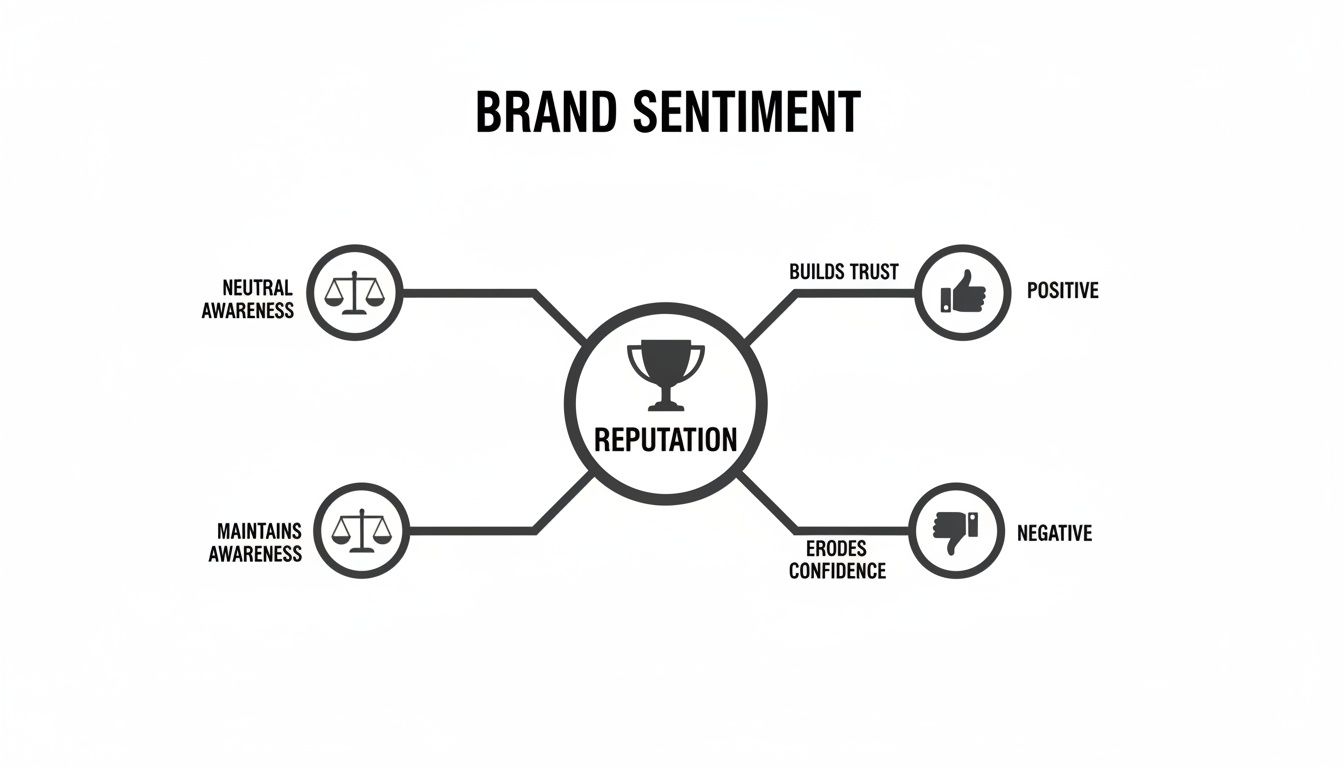
As you can see, reputation isn't just one score. It's a delicate balance of the good, the bad, and the indifferent.
The New Frontier: AI-Driven Sentiment Analysis
The shortcomings of keyword-counters created a clear need for something smarter. Enter ai brand sentiment analysis tools. Instead of just counting words, these next-generation platforms analyze how large language models (LLMs) like Claude, Gemini, and ChatGPT actually perceive and talk about your brand.
This isn't just a minor upgrade; it's a completely different way of thinking. Millions of people are now asking AI for product comparisons, recommendations, and quick summaries. The sentiment baked into those AI-generated answers is directly shaping what your potential customers think and do.
Platforms like promptposition were built for this new reality. They move beyond the noise of social media to measure your brand’s reputation where it increasingly matters most: inside the AI models that are quickly becoming the world's new source of truth. This unlocks a critical, previously invisible layer of your brand’s digital health.
The table below breaks down the core differences between the old way and the new way of measuring sentiment.
Traditional Social Listening vs AI Sentiment Analysis
This comparison highlights the key differences in data sources, accuracy, and the kind of strategic value you can expect from each approach.
| Feature | Traditional Social Listening Tools | AI Brand Sentiment Analysis (e.g., promptposition) |
|---|---|---|
| Primary Data Source | Public social media posts, news articles, reviews | Outputs from Large Language Models (LLMs) like Gemini, ChatGPT, Claude |
| Core Methodology | Keyword matching and rule-based classification | Analysis of generative AI's perception, tone, and descriptive language |
| Accuracy | Prone to errors with sarcasm, irony, and complex context | High accuracy in understanding nuance, context, and implied meaning |
| Scope of Insight | Measures public conversation and mention volume | Measures the authoritative summary and perception being served to users |
| Strategic Focus | Reactive monitoring of brand mentions and crisis management | Proactive reputation management and influencing future AI-driven narratives |
| Key Blind Spot | Ignores the growing influence of AI-generated information | Does not directly capture individual, real-time social media posts |
As you can see, AI-powered analysis isn't just about getting a more accurate score; it’s about understanding and shaping your brand’s reputation in the places where modern discovery begins.
Key Metrics for Tracking Brand Sentiment
To really get a handle on your brand's reputation, you have to turn those fuzzy feelings into cold, hard data. Tracking the right metrics is what elevates brand sentiment from a vague idea into a sharp tool for making smart decisions. Think of these key performance indicators (KPIs) as your brand's vital signs—they tell you exactly how you're doing and where you need to focus your energy.
It’s a bit like flying a plane. You wouldn't rely on just one instrument to get you there safely. Alongside altitude, you need to know your airspeed, fuel level, and direction. In the same way, a solid brand sentiment analysis needs a blend of basic and more sophisticated metrics to give you the full picture.
Foundational Brand Sentiment KPIs
These are the absolute essentials, the metrics that form the foundation of any sentiment tracking you do. They give you that crucial high-level view of the conversation about your brand and are perfect for setting a baseline.
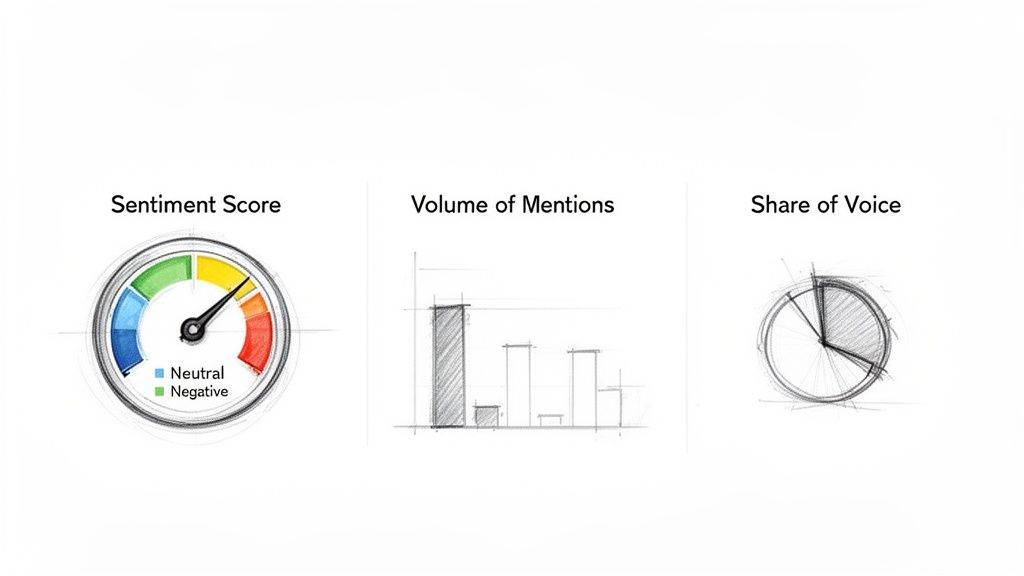
Sentiment Score: This is your most direct read on public opinion. It boils down the conversation into a simple ratio of positive, negative, and neutral mentions. You’ll often see it as a single score (like +65 or -20) or a percentage breakdown (say, 50% positive, 20% negative, 30% neutral). A consistently rising score is a great sign that your brand strategy is hitting the mark.
Volume of Mentions: At its core, this is a simple count of how many times your brand is being talked about online over a set period. A sudden spike in mentions isn't automatically good or bad—you need the context from your Sentiment Score to understand it. For example, a huge jump in volume paired with negative sentiment could be the first sign of a crisis.
Share of Voice (SOV): This metric sizes you up against the competition by comparing your brand mentions to theirs. If your industry generates 1,000 total mentions in a day and 250 of them are about you, your SOV is 25%. It's a straightforward way to see how much of the conversation you actually own.
These KPIs are the right place to start, but they only show one side of the coin. They’re great for measuring the public conversation, but they often miss the powerful perceptions now being shaped inside AI systems.
A high Share of Voice is only valuable if the voice is positive. Tracking volume without sentiment is like measuring applause without knowing if it’s genuine praise or sarcastic clapping.
Advanced AI-Specific Sentiment Metrics
With AI-powered search becoming a go-to source for information, we need a new set of metrics to understand how our brands are being portrayed within these models. These advanced KPIs, often found in specialized ai brand sentiment analysis tools, uncover insights that traditional social listening just can't touch.
AI Visibility Score: This metric answers the most basic question: when someone asks an AI about your industry, does your brand even show up? It measures how often you appear in AI-generated answers for your most important topics. If you have low visibility, your sentiment score is irrelevant because you're not even in the conversation.
Sentiment Trend Over Time: This is where you move from a single snapshot to a moving picture. By plotting your sentiment score against your competitors' over weeks or months, you can start to see meaningful patterns. Did your sentiment drop right after a competitor launched a new product? Did it get a boost from your last marketing campaign?
Source Influence Analysis: This is easily one of the most powerful AI-driven metrics available. It digs deep to find the exact articles, reviews, and websites that an LLM is using to form its opinion of you. If you discover an AI keeps referencing an old, negative review, you know precisely where to direct your PR and content efforts to fix it. You can learn more about how to use AI for SEO in our detailed guide.
By creating a dashboard that pulls together both foundational and advanced metrics, you build a truly comprehensive system for brand sentiment analysis. This doesn't just show you how people and AI see you today—it gives you the roadmap to strategically shape that perception for tomorrow.
Real-World Examples of Brand Sentiment in Action
Knowing the metrics is one thing, but seeing brand sentiment play out in the real world is where you really grasp its power. These examples show just how quickly public and AI perception can make or break a brand, hammering home why you can't afford to look away.
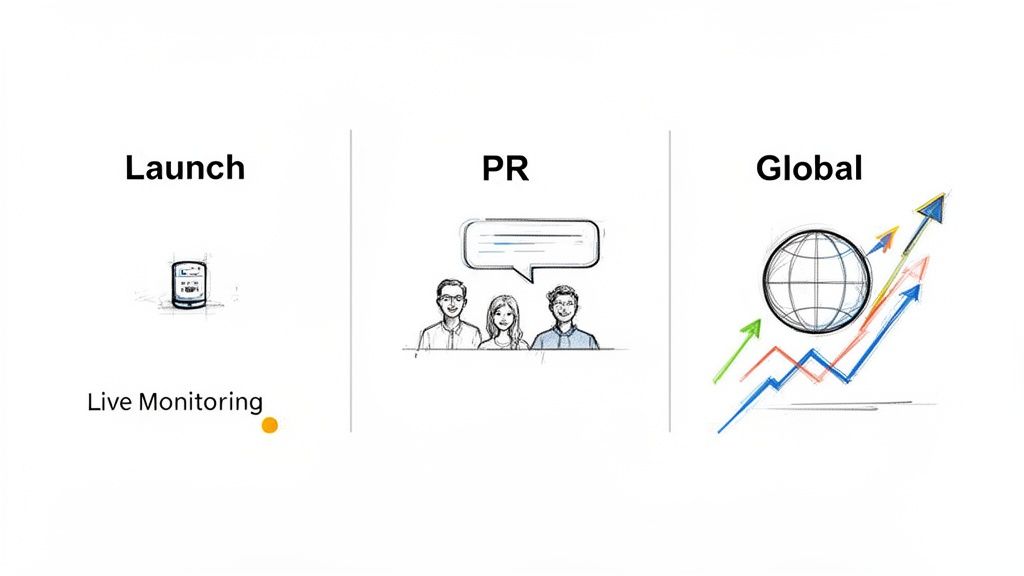
Picture a tech company dropping its much-hyped new gadget. Within hours of the launch, brand sentiment analysis tools start buzzing with negative chatter. The culprit? Poor battery life. Instead of waiting weeks for sales reports or formal reviews to trickle in, the product team gets the raw feedback in real-time.
Because they saw the problem early, they were able to fast-track a software update to fix it. This quick action flipped the script before the negative narrative could cement itself in the minds of reviewers and potential buyers. What could have been a launch disaster became a masterclass in responsive customer service, turning a wave of negative sentiment into a positive one.
Navigating a Public Relations Crisis
Now, think about a beloved consumer brand that stumbles into a PR nightmare after launching a tone-deaf ad campaign. The backlash on social media is instant and brutal, and their sentiment score nosedives.
A smart communications team doesn't just panic and react. They use this as a chance to actually listen. By digging into the sentiment data, they pinpoint exactly which parts of the ad hit the wrong nerve. This allows them to issue a genuine, specific apology that addresses the public’s real concerns, not just a generic "we're sorry." They immediately pull the ad.
Over the next few weeks, they keep a close eye on the conversation. They watch as the angry mentions slowly fade, replaced by a cautious respect for how they handled the situation. It’s a perfect example of using sentiment analysis as a compass to navigate a storm.
The Ripple Effect of Global Trends
Brand sentiment isn't just about what your company does. It's often at the mercy of much bigger forces. Things like economic instability, social movements, or global conflicts can completely change how people see entire countries—and by extension, the brands associated with them.
A brand's reputation doesn't exist in a vacuum. It is constantly being shaped by the cultural and economic tides, and ignoring these external forces is a major risk.
This was thrown into sharp relief by the Global Soft Power Index from Brand Finance. The report found that the United States had the biggest drop in brand sentiment out of all 193 nations, falling 4.6 points. This wasn't a small focus group; this shift was based on input from over 150,000 people globally. The reason? Widespread economic and social pressures that chipped away at trust, a pattern that echoed across many Western nations.
These stories all teach the same lesson. The narrative is always changing, whether it's a product bug being debated on Reddit, a PR fumble going viral on X, or a global event reshaping public opinion. The brands that not only survive but thrive are the ones that are constantly listening and adapting. In this day and age, ignoring the conversation—whether it's happening between people or being summarized by AI—simply isn't an option.
A Strategic Guide to Improving Your Brand Sentiment
Knowing where your brand sentiment stands is one thing; actually shaping it is where the real work begins. Improving your brand’s reputation isn’t about a one-off campaign or a few quick fixes. It’s about creating a continuous, data-driven feedback loop that moves your teams from putting out fires to proactively building a brand people love.
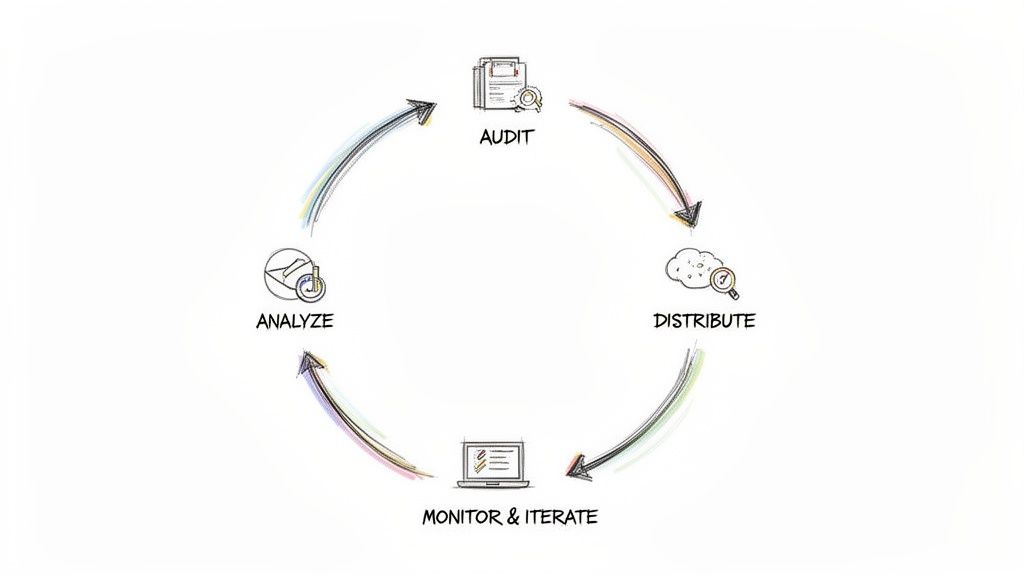
And let's be clear: this isn't just a job for the PR team. This process requires a united front across marketing, content, and even product development to make sure every single customer touchpoint tells the right story.
Establish a Comprehensive Sentiment Baseline
You can't map out a route to your destination if you don't know where you're starting from. The first move is always a deep-dive sentiment audit using modern brand sentiment analysis tools. This is more than just getting a simple score; it's about drawing a detailed map of how the world sees you right now.
Your initial audit needs to capture a few crucial data points:
- Overall Sentiment Score: Your main benchmark, showing the breakdown of positive, negative, and neutral mentions.
- Competitor Benchmarks: How do you stack up against your top two or three rivals? Are you leading the pack or falling behind?
- Key Themes: What specific topics, products, or features are consistently popping up in both glowing reviews and angry rants?
- Source Analysis: Which websites, articles, or reviews hold the most sway, especially in the "mind" of AI models?
Think of this baseline as your "before" picture. It’s the essential starting point you'll use to measure the impact of everything you do from here on out.
Identify and Address Root Causes
With your baseline in hand, it’s time to put on your detective hat. Negative sentiment rarely comes out of nowhere—there's almost always a root cause. Your job is to dig into the data and uncover the "why." This means looking past the percentages and reading the actual verbatim feedback.
For instance, if you notice a sudden spike in negative mentions, don't just log the dip in a spreadsheet. Use your brand sentiment analysis tools to read the comments. You might find out the problem isn't your entire product, but a confusing new feature or a poorly communicated price change.
Vague negative feedback is just noise. Specific, analyzed feedback is a strategic roadmap. It tells you exactly what problem you need to solve to improve how customers and AI perceive your brand.
By pinpointing the reason behind the numbers, you can get straight to the solution. Maybe you need to alert the product team to a bug, have customer support create a new help article, or get your content team to clear up a common misconception.
Develop Targeted Content and PR Campaigns
Once you understand the 'why,' you can finally shift from defense to offense. The goal here is to create and promote content that reinforces the good stuff while directly countering the bad. This is absolutely critical for shaping the information that both people and AI models use to form an opinion about your brand.
A solid strategy involves a few key moves:
- Reinforce Positives: Find out what people already love about you and shout it from the rooftops. If customers rave about your stellar support, create case studies, testimonials, and social posts that prove it.
- Counter Negatives: Did your analysis show that a negative review from two years ago is still poisoning your AI-generated sentiment? It’s time for a targeted PR push. Focus on getting fresh, positive coverage on authoritative sites to knock that old content down in relevance.
- Fill Information Gaps: Use a tool like promptposition to see where AI mentions your competitors but leaves you out. Then, create high-quality, targeted content that answers those specific user questions and cements your brand as an expert. If you're new to this concept, our guide explains what Generative Engine optimization is and how it works.
This proactive approach means you’re no longer a bystander—you're an active participant in the conversation about your brand.
The link between a strong brand and market success has never been clearer. Recently, a record 37 brands in Brand Finance's Global 500 earned the elite AAA+ brand strength rating, a testament to incredibly powerful positive sentiment. This comes as the digital marketing sector itself grows at a 9% compound annual rate, proving how a dominant brand directly fuels business growth. Discover more insights on brand strength in the full report.
By creating this cycle of auditing, analyzing, and acting, you build a resilient brand reputation that can turn challenges into opportunities.
The Future of Brand Perception in an AI-Driven World
The ground is shifting beneath our feet. For years, we've obsessed over Google rankings, but the next frontier of brand management is already here, and it's being shaped by algorithms. As generative AI and large language models (LLMs) become the go-to starting point for people's questions, what these systems think about your brand is about to become your new reality.
This isn't some far-off prediction. It's happening right now. Every review, every article, every forum discussion—it's all raw data feeding an AI's understanding of who you are. The brands that will win the next decade are the ones who figure out how to manage their presence in this new AI-powered search landscape.
Why Your AI Reputation Is Your New Reality
We've all gotten comfortable with social listening, and it's still an important piece of the puzzle. But it only really captures the public, real-time conversation. ai brand sentiment analysis tools take it a step further. They measure the authoritative summary an AI model puts together after digesting everything out there about you.
Think about it: this AI-generated perception is the first impression millions of potential customers will have. It's the summary they get before they even click a link.
The urgency to get this right is obvious when you look at the market. The global demand for sentiment analysis is expected to explode from USD 3,944.9 million to an incredible USD 17,048.5 million by 2030. That's a compound annual growth rate of 27.7%, a clear signal that marketing teams are scrambling to understand what consumers—and the AIs that serve them—are feeling. You can read the full analysis on the market's trajectory here.
Adapting Your Strategy for Tomorrow
Staying ahead in this new environment means being proactive, not just reactive. It’s time to start thinking differently about how we build and protect our brands.
Here's how to begin that shift:
- Look Beyond Keywords: Your goal is no longer just to rank for terms. It's to influence the entire narrative and context surrounding your brand online.
- Treat AI as a Key Audience: Think of these AI models as a new, incredibly influential persona. What high-quality information do they need to form an accurate and positive opinion of you?
- Focus on Source Quality: Find the positive, authoritative sources that AIs are most likely to trust and reference. Then, work to amplify them.
In the past, you had to win over customers one at a time. Now, you also have to win over the AI that speaks to millions of them at once. The sentiment it projects becomes their starting point.
This is more than just another channel to manage. It's a fundamental change in how reputations are built. Understanding the nuances of brand sentiment within this AI ecosystem is the critical first step. To get a handle on this evolving field, check out our guide on AI search engine optimization.
The brands that master this new landscape won’t just survive; they will define the future of their industries.
Brand Sentiment FAQs
Let's tackle some of the most common questions that come up when teams start working with brand sentiment. Think of this as a quick-reference guide to clear up any lingering confusion.
Brand Sentiment vs. Brand Awareness: What's the Difference?
It’s easy to mix these two up, but they tell you very different things about your brand's health.
Think of it like this: Brand awareness is about recognition—do people even know you exist? It's the "what." Brand sentiment, on the other hand, is about reputation—how do they feel about you? It's the "how."
A brand can have massive awareness for all the wrong reasons, like a PR disaster. Lots of people know the name, but the feeling attached to it is negative. The real goal is high awareness and positive sentiment. One without the other is a job half-done.
Can Brand Sentiment Actually Predict Sales?
While it’s not a magic 8-ball for predicting next quarter's revenue, brand sentiment is a surprisingly strong leading indicator of where things are headed.
A steady climb in positive sentiment often points to happier, more loyal customers who are more likely to make repeat purchases. It’s a sign that the way people feel about your brand is getting stronger, which almost always translates to sales growth down the line.
On the flip side, a sudden nosedive in sentiment can be your canary in the coal mine, warning you of potential revenue dips. It gives you a head start to figure out what’s wrong and fix it before it starts to impact your bottom line.
How Often Should We Be Measuring This Stuff?
The ideal rhythm really depends on what’s going on with your business. For just keeping a pulse on your brand and establishing a baseline, checking in monthly or quarterly is a great start. This helps you see the forest for the trees and spot long-term trends.
But when things get intense, you need to ramp up your monitoring. During a product launch, a big marketing push, or a brewing crisis, you’ll want to be checking sentiment daily, or even in real-time. Modern brand sentiment analysis tools are built for this, giving your team the live feedback needed to act fast when it counts the most.
Ready to see how your brand is perceived by the world's most influential AI models? promptposition provides the visibility and sentiment data you need to build a stronger brand reputation in the AI era. Start tracking your AI brand sentiment today.