How to Use AI for SEO: A Modern Marketer’s Guide
Using AI for SEO means weaving intelligent tools into your existing search optimization workflow to speed up, enhance, and ultimately drive your daily tasks toward better results. It all starts with setting clear goals, picking the right AI models and tools, and mastering the art of the prompt. From there, you can use AI to create, fine-tune, and measure your content's real-world impact. This isn't about replacing talented SEOs; it’s about giving them superpowers to work more efficiently, make smarter decisions, and hit new performance benchmarks.
The New SEO Playbook: Where AI Meets Strategy

Welcome to the new frontier of search. Integrating artificial intelligence into your SEO strategy isn't a future concept—it's an immediate necessity to stay competitive. This evolution is a leap from old-school, manual tactics to a modern, supercharged approach where AI acts as a core component of your toolkit, empowering you to make smarter, faster decisions.
The conversation has moved beyond just asking AI to churn out a few blog posts. We're now talking about a comprehensive strategic framework that touches every part of the SEO lifecycle. This means leveraging AI for everything from deep-dive keyword research and topic clustering to technical site audits and performance analysis.
Why This Shift Is Happening Now
Generative AI is fundamentally changing how people find information. Businesses that have started integrating AI into their content strategies are already seeing the rewards, with some reporting up to a 45% increase in organic traffic and a 38% jump in conversion rates for e-commerce. With projections showing that 90 million American adults will be using AI for search by 2027, there's no time to wait.
This demands a completely new playbook. It’s no longer just about ranking on Google. You now have to ensure your brand is visible, accurately represented, and recommended within the answers generated by models like ChatGPT and Gemini.
The goal isn't to put your SEO strategy on autopilot. Think of AI as your most powerful assistant—one that can sift through massive datasets, spot hidden patterns, and handle tasks at a scale that's simply out of reach for a human team alone. This frees you up for what truly matters: strategy.
So, how does this look in practice? The table below breaks down the difference between the old way and the new, AI-powered way of doing things, showing how AI makes each step more actionable.
Traditional SEO vs AI-Powered SEO
| SEO Task | Traditional Approach | AI-Powered Approach |
|---|---|---|
| Keyword Research | Manual analysis of SERPs and keyword tools. | AI-driven analysis of user intent, topic clustering, and predictive keyword opportunities. |
| Content Creation | Human writers create content based on a brief. | AI assists with outlines, drafts, and data points, freeing up writers for creativity and strategy. |
| On-Page SEO | Manually writing meta tags, alt text, and internal links. | AI generates optimized suggestions for meta tags and internal links at scale. |
| Technical SEO | Manually crawling sites and analyzing log files. | AI identifies technical issues, predicts their impact, and even suggests code fixes. |
| Performance Tracking | Reviewing rankings and traffic in analytics platforms. | AI tracks brand visibility in generative answers and analyzes sentiment, providing new KPIs. |
As you can see, AI doesn't replace the core tasks of SEO. It elevates them, making them faster, smarter, and more data-driven.
From Abstract Answers to Actionable Analytics
One of the biggest hurdles in using AI for SEO is figuring out how to measure its impact. How do you turn a conversational answer from a chatbot into cold, hard data you can act on? This is where specialized platforms come in. An AI search analytics tool like promptposition can track your brand’s visibility and sentiment across different language models, giving you concrete KPIs to work with.
This modern approach involves a few key shifts:
- Setting specific goals: Instead of just "increase traffic," you aim to "improve positive brand mentions in AI answers by 15%."
- Mastering prompt engineering: You learn to ask the right questions to get strategic, useful outputs from AI, not just generic fluff.
- Amplifying human expertise: AI handles the grunt work, which frees up your team to focus on high-level strategy, creativity, and nuanced analysis. For more on this, you might be interested in our deep dive on AI search engine optimization.
This guide is your direct, no-nonsense introduction to this new reality, showing you how to build a practical framework for getting real results.
Building Your AI SEO Foundation: Goals and Tools
Before you write a single AI-assisted sentence, you need to lay the groundwork. Jumping into generative AI for SEO without a clear plan is like setting sail without a map—you'll be busy, but you won't get anywhere meaningful. A smart, actionable strategy begins with defining exactly what you want to achieve and picking the right tools for the job.
It's easy to set a vague goal like "increase traffic," but that won't get you far. You need specific, tangible targets to give your AI efforts real direction and make your success measurable.
For instance, you could aim to:
- Improve rankings for long-tail keywords by 20% in the next quarter by using AI to spot and create content for underserved topics.
- Reduce content production time by 30%, letting AI handle first drafts and outlines so your team can focus on strategy and polishing.
- Increase the publication of new landing pages by 50% per month by scaling content creation with AI.
Setting concrete targets like these turns AI from a fun experiment into a core business function with clear expectations.
Choosing Your AI Toolkit
With your goals locked in, it’s time to choose your technology. The market for AI SEO software is exploding, and for good reason. It was valued at $1.99 billion and is expected to hit $4.97 billion by 2033.
This growth is fueled by real results. A solid 52% of marketers credit AI for making them more efficient, especially with tasks like on-page optimization. And the proof is in the traffic: businesses using AI have seen visits from AI assistants grow 9.7x year-over-year, and those visitors convert a staggering 23x better than typical organic traffic. You can dig deeper into these AI SEO statistics and their impact to see the full picture.
The key isn't to find one magic tool, but to build a stack that works for you. This usually involves two kinds of tools.
1. General Large Language Models (LLMs)
Models like OpenAI's GPT-4 and Anthropic's Claude 3 are incredibly versatile. They’re perfect for brainstorming keywords, drafting initial content, and summarizing research. Think of them as your multi-purpose Swiss Army knife for getting ideas flowing and work started.
Pro Tip: Use different LLMs for different tasks. Claude 3, for instance, often produces more natural-sounding prose for first drafts, making it great for blog content. GPT-4 excels at structured tasks like generating schema markup or analyzing data patterns, where precision is key.
2. Specialized AI SEO Platforms
While general LLMs are powerful, they don't have the deep analytics needed for a full-blown SEO strategy. Specialized software is built from the ground up to handle specific SEO workflows with much greater precision. These platforms can automate technical audits, give you real-time content scores against SERP competitors, and analyze your site’s structure for new internal linking opportunities.
The Missing Piece: AI Search Analytics
There’s a critical component many marketers are still overlooking: AI search analytics. It’s one thing to use AI to create content; it’s another thing entirely to know how that content actually influences the AI models themselves. This is where a platform like promptposition becomes essential.
Your standard analytics tools can't tell you if your brand is being recommended in ChatGPT or Gemini. An AI search analytics platform fills this crucial gap, monitoring your brand’s visibility, sentiment, and positioning directly inside LLM responses. This is where you connect your actions to outcomes.
This gives you answers to the questions that really matter:
- How often is our brand mentioned when users ask for solutions?
- Is the sentiment around our brand positive or negative in AI-generated answers?
- Which competitors are showing up in responses where we should be?
By making these informed decisions on your goals and tools right from the start, you ensure every AI-driven action you take is targeted, effective, and—most importantly—measurable.
Getting Your Hands Dirty: Crafting High-Impact Content with AI
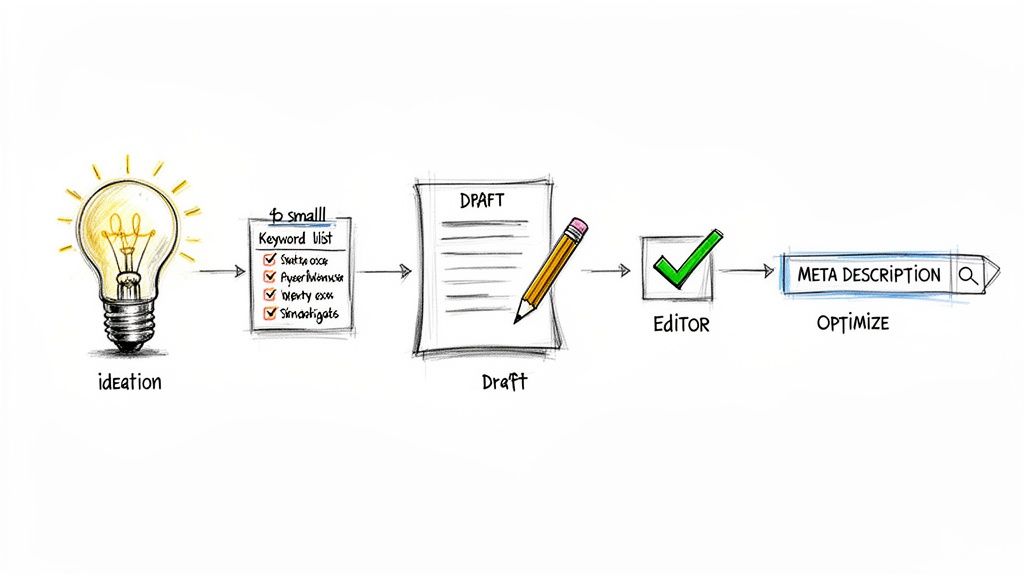
This is where strategy becomes action. With your plan in place and tools at the ready, you can start weaving AI into your day-to-day content workflow. The goal isn't to hit a button and walk away; it's about moving from a blank page to a fully optimized asset faster and smarter than ever before.
The real shift is in your role. Think of AI as an incredibly capable research assistant and first-draft intern. It handles the initial grunt work, freeing you up to focus on the big-picture strategy, creative direction, and the nuanced edits that separate great content from the sea of mediocrity.
Engineering Prompts That Actually Work for SEO
The quality of what you get out of an AI is directly tied to the quality of what you put in. Simply asking it to "write a blog post about SEO" will get you a generic, uninspired piece that won't rank for anything meaningful. This is where prompt engineering comes into play, and it's a skill you must develop.
A great SEO prompt doesn't just ask for something; it gives the AI a role, provides deep context, and tells it exactly how to structure the response. It’s the difference between hiring a random freelancer and briefing an expert on your team.
For instance, if I’m building out a content outline, I'll use a detailed brief like this to drive a useful result:
Act as an expert SEO content strategist. I am creating a comprehensive blog post targeting the keyword "how to use AI for SEO." My target audience is marketing managers with intermediate SEO knowledge. Generate a detailed, H2 and H3-level outline for this post. For each section, include the key topics to cover and suggest relevant LSI keywords. The tone should be informative and actionable.
See the difference? That level of detail is what guides the AI to produce something genuinely useful and strategically sound.
From Single Keywords to Dominant Topic Clusters
The early stages of content strategy—keyword research and topic planning—can be a massive time sink. AI turns hours of manual work into minutes of strategic analysis, helping you build authority faster.
You can use it to build out entire topic clusters that signal your site's expertise to search engines.
- Brainstorming Keywords: Give the AI a core keyword and ask for long-tail variations, common questions people ask, and semantically related terms. It's like having an instant focus group.
- Building Clusters: Hand it a list of keywords and tell it to organize them into logical topic clusters, identifying the main "pillar" and supporting "cluster" pages. This is a huge strategic shortcut.
- Simulating SERP Analysis: Ask the AI to act as a SERP analyst. Give it a target keyword and have it summarize the common themes, user intent, and content formats of the top-ranking pages. This helps you understand the competitive landscape without hours of manual review.
This isn't about replacing tools like Ahrefs or Semrush; it's about accelerating the creative and analytical process that happens between pulling the data.
The Human-AI Partnership in Content Drafting
With a solid, AI-assisted outline in hand, you can now have the AI generate a first draft. But this is the most critical stage for human intervention. Google's stance is clear: they reward helpful, high-quality content, period. The method of creation doesn't matter as much as the final product's ability to meet their E-E-A-T (Experience, Expertise, Authoritativeness, and Trustworthiness) standards.
Let's be blunt: AI has no real-world experience. It has never managed an SEO campaign, analyzed a traffic drop, or celebrated a page-one ranking. It can only synthesize information that already exists online.
The most effective workflow is a hybrid one. Use AI to generate about 80% of the foundational content—the definitions, the structural elements, the basic explanations. Then, a human expert must come in to add the critical 20%: original insights, personal anecdotes, unique data, and a distinct point of view.
Your job title effectively becomes Editor-in-Chief. You're there to fact-check, inject your brand's voice, and add the irreplaceable human elements that an LLM simply cannot replicate.
Breathing New Life into Existing Content
AI isn't just for creating new things; it's an incredible tool for optimizing what you already have. It can look at your content with a completely unbiased "eye" and spot opportunities you might have missed.
Here are a few practical ways to use AI for content optimization today:
- Spot Content Gaps: Copy your article's text into an LLM, then paste in a top-ranking competitor's article. The prompt is simple: "Identify topics and keywords this competitor covers that I missed." This gives you an instant to-do list for your next update.
- Punch Up Readability: If a piece feels dense, ask the AI to analyze it for readability. It can flag complex sentences, suggest simpler words, and recommend better formatting to improve the user experience.
- Craft Click-Worthy Meta Data: Just provide the article's text and ask the AI to generate five different meta title and description variations under the character limit, each with a compelling call-to-action. It's a great way to kickstart A/B testing ideas for SERP CTR.
This seamless cycle—from ideation and drafting to ongoing optimization—is what unlocks the true potential of AI in an SEO context. It clears your plate of the tedious tasks so you can pour your energy into the high-impact strategy that actually drives results.
Getting Your Hands Dirty: AI for Technical SEO
Content might be king, but technical SEO is the foundation of the entire kingdom. While flashy AI content tools get all the attention, some of the biggest and most immediate wins are on the technical side. This is where AI helps you build a healthier, more crawlable website—the kind of stuff that pays off in the long run.
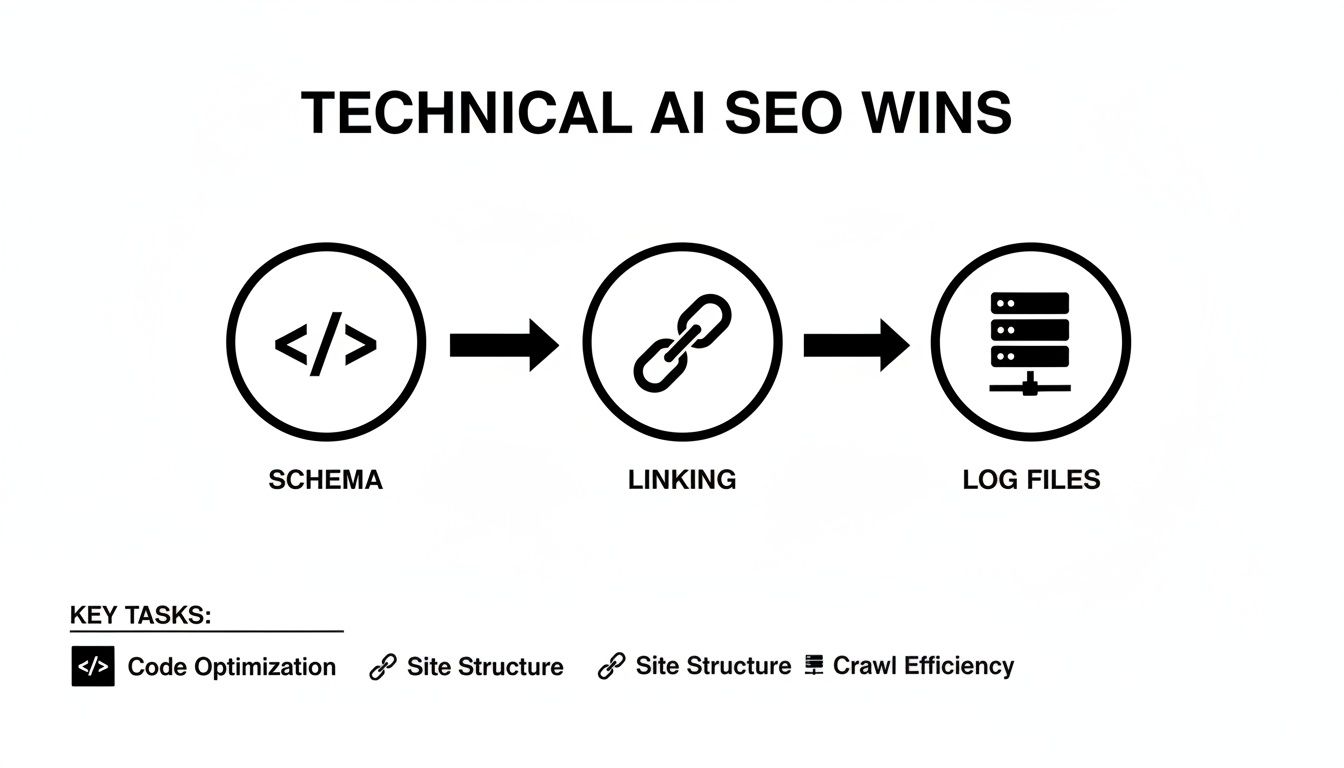
Think about all the manual, tedious tasks that technical SEO pros have to deal with. From generating structured data to combing through massive log files, these jobs are prone to human error and can eat up days. AI excels at this kind of work, processing information at a scale that gives you a real edge.
Automating Schema Markup at Scale
Structured data, or Schema markup, is that bit of code that tells search engines what your content is about. It's what turns a standard search listing into an eye-catching rich snippet. But writing JSON-LD scripts for hundreds, let alone thousands, of pages? That's a nightmare.
AI turns this into a surprisingly simple task.
You can just give an AI model a URL or a snippet of product info and tell it what to do. This is an actionable way to make your content more understandable to search engines.
For instance, you could prompt it with something like this:
"Generate a JSON-LD script for a 'Product' schema. The product is the 'Pro-Grade Coffee Grinder,' priced at $149.99. It has a 4.8-star rating from 257 reviews and is currently in stock. The brand is 'BeanMaster.' Make sure to add a short description."
Imagine hooking this up to an API. You could automatically generate perfect schema for your entire product catalog or blog archive in a fraction of the time it would take a developer. That means your content gets eligible for rich results without all the manual coding headaches.
Building Smarter Internal Linking Strategies
A solid internal linking structure does more than just help users find their way around. It's crucial for spreading authority throughout your site and showing Google how your content is related. But on a big site, finding the best places to add links often feels like a shot in the dark.
This is where AI can really shine by analyzing your entire website to create a map of your content and topics.
- Find contextual links: AI tools can scan your articles and suggest relevant internal links, helping you strengthen your topic clusters without having to remember every post you've ever published.
- Discover orphaned pages: It can quickly identify pages that have few or no internal links pointing to them—pages that search engines might struggle to find and index.
- Optimize anchor text: Instead of just using generic phrases like "click here," you can ask an AI to suggest a variety of keyword-rich anchor text options for links pointing to a specific page.
This shifts your internal linking from a gut-feeling exercise to a data-driven strategy. What was once a manual chore becomes a powerful way to improve crawlability and guide users to your most important content.
Unlocking the Secrets in Your Log Files
Log file analysis is the art of digging into raw server logs to see exactly how search engine bots crawl your site. The data here is pure gold, but it's also incredibly dense. A single log file can contain millions of lines, making it almost impossible for a human to analyze effectively.
AI is built for this kind of heavy lifting. When you feed server logs into an AI-powered analytics tool, you can pull out critical insights in minutes, not days.
AI can instantly sift through massive log files to spot patterns a human would never catch. Think about it: identifying which pages are crawled most often, seeing how bots are handling complex redirect chains, or figuring out if they're wasting crawl budget on low-value URLs.
This process helps you answer really important questions:
- Are search engine bots spending too much time on unimportant pages?
- Is Googlebot constantly running into 404 errors?
- Are the sections of your site getting the most crawl attention actually your business priorities?
By using AI for these technical tasks, you're doing more than just saving time. You're getting a much clearer picture of your site's technical health and uncovering optimization opportunities that were buried deep in the data.
Measuring Success in the Age of AI Search
If you can't measure it, you can't improve it. That old saying has never been more true than with AI-driven SEO. The game has changed, and frankly, relying on old-school metrics like keyword rankings and organic traffic is like navigating a new city with a map from 1995. You're going to get lost.
Success today means understanding your visibility inside the answers generated by models like ChatGPT and Gemini. This is a space where your traditional analytics tools are completely blind.
Shifting from SERP Rankings to AI Visibility
We need a new framework, and that starts with a new set of Key Performance Indicators (KPIs) built for this new world. The goal is to stop obsessing over where you rank on a list of blue links and start measuring how often—and how favorably—your brand shows up in AI-generated responses.
This is the essence of AI Search Visibility.
Your New North Star Metrics
To really get a handle on your performance, you have to adopt metrics that reflect this new reality. These aren’t just vanity numbers; they're direct signals of your influence on the large language models that are quickly becoming the new gatekeepers of information.
Here’s what you should be tracking:
- Share of Voice in AI Answers: This is your new market share metric. It calculates the percentage of times your brand gets mentioned in AI responses for a core set of prompts, directly measured against your competitors. It's the ultimate benchmark for brand presence.
- Source Citation Rate: This KPI tracks how often your website's content is cited as a source. A high citation rate is a clear sign that the models view your content as authoritative and trustworthy.
- Sentiment Analysis: This goes beyond a simple mention. Is the AI describing your brand in a positive, negative, or neutral light? A sudden shift in sentiment can be the canary in the coal mine for a brewing reputational issue.
- Visibility Gaps: This is where you find your opportunities. It’s an analysis that pinpoints high-value prompts where your competitors are getting mentioned, but you're nowhere to be found. This gives you a direct, actionable roadmap for future content and PR.
Getting these metrics right often starts with a solid technical foundation. Mastering things like structured data and smart internal linking is fundamental to getting AI models to trust and reference your site in the first place.
Tracking What Matters: A Look at New KPIs
To put this into perspective, let's compare the old way of thinking with the new. While traditional metrics still have their place, they don't give you the full picture anymore. You need to layer on AI-centric KPIs to truly understand your performance.
The table below breaks down this shift, showing how you can get a more complete view of your SEO efforts.
Key Performance Indicators for AI SEO
| Metric Category | Traditional SEO KPI | AI Search KPI (via promptposition) |
|---|---|---|
| Visibility | Keyword Rankings | Share of Voice in AI Answers |
| Authority | Backlink Count & Domain Authority | Source Citation Rate |
| Brand Perception | Brand Mentions | Sentiment Analysis Score |
| Competitive | Competitor Rank Tracking | Competitor Visibility Gaps in AI |
By combining these, you move from simply tracking positions to understanding influence.
From Data Points to Actionable Strategy
Knowing what to track is one thing, but actually doing it is another challenge entirely. This is where an AI search analytics platform like promptposition becomes indispensable. It turns the black box of AI answers into a clear, data-driven dashboard.
Instead of guessing, you can see exactly how your brand is performing against the competition in real time. This level of analysis lets you pinpoint which specific content is influencing the models and which competitors are winning the AI visibility race.
By continuously monitoring these new KPIs, you can see exactly what content is shaping the AI’s “opinion” of your brand. This transforms AI from a simple creative tool into a measurable marketing channel with a clear and demonstrable ROI.
The stakes for getting this right are massive. Some projections show AI search is on a path to eclipse traditional organic traffic by early 2028. Even more critically, visitors from an AI search tool convert at 4.4x the rate of a traditional organic visitor, making every AI-driven click incredibly valuable.
What’s really interesting is that AI tools like ChatGPT pull citations from pages ranking 21+ in traditional search nearly 90% of the time. This opens up a huge opportunity for smaller players to gain visibility if they optimize smartly. You can learn more about these AI search findings and see why this is a channel you simply can’t afford to ignore.
This data-driven approach allows you to justify your AI SEO strategy and prove its value. It moves the conversation with stakeholders from “Are we using AI?” to “How is our AI strategy impacting the bottom line?”
Common Questions About Using AI for SEO
As you start weaving AI into your SEO workflow, you’re going to have questions. It’s a new frontier, and a healthy dose of curiosity is a good thing. Let’s tackle some of the most common sticking points we see marketers run into.
Will Google Penalize Me for Using AI Content?
The short answer is no, provided the content is actually good.
Google has been pretty clear on this: they reward helpful content created for people, no matter how it was made. Their beef is with using automation—AI included—to churn out low-effort, spammy junk designed solely to game the system.
So, if you’re using AI as a partner to create well-researched, genuinely useful content that hits all the E-E-A-T marks, you’re in the clear. The trouble starts when people use it to mass-produce unedited, generic articles that offer zero real value.
The real focus should be on quality, not the creation method. If your content truly helps the user, Google won’t care how it was drafted. That human touch—your experience, fact-checking, and unique perspective—is what makes AI-assisted content not just safe, but powerful.
How Much Editing Does AI-Generated Content Really Need?
This really depends on two things: the complexity of your topic and the quality of your prompt. For a straightforward informational blog post, a well-prompted model like Claude 3 or GPT-4 can give you a first draft that might just need a few tweaks to match your brand voice.
But for anything technical or nuanced, you have to treat the AI output as a starting point, not a finished product.
Here’s a practical checklist for your human review process:
- Factual Accuracy: This is non-negotiable. Always verify every statistic, claim, and technical detail. AI is notorious for “hallucinating” facts or citing outdated information.
- Originality and Depth: What do you know that the AI doesn’t? Add your unique insights, personal stories, or proprietary data. This is where you really build authority.
- Brand Voice: AI tends to write in a very neutral, almost bland, tone. You need to inject your brand’s personality and style.
- Readability and Flow: Chop up long sentences, hunt down repetitive phrases, and ensure the whole piece reads like it was written by a human who cares.
I like to use the 80/20 rule: let the AI do 80% of the heavy lifting, but reserve the crucial 20% for a human expert to provide the refinement, fact-checking, and originality that makes it stand out.
Can AI Content Rank Faster Than Human-Written Content?
Not on its own, no. A page’s ranking speed is tied to dozens of signals—site authority, backlinks, niche competition, and the quality of the content itself. An AI-generated article doesn’t get a special fast-pass through Google’s indexing and ranking systems.
What AI does do is dramatically speed up your entire content production process. This means you can publish high-quality, optimized content much more frequently. That increased velocity is what leads to faster results over time, simply because you’re creating more ranking opportunities. We dig into this a lot more in the articles on the promptposition blog.
Think of it like this: AI doesn’t give you a shortcut on the racetrack, but it can give you a much faster car. You still have to be a skilled driver to win.
Ready to stop guessing and start measuring your brand’s visibility in AI search? promptposition gives you the data-driven insights you need to understand and optimize how LLMs see your brand. Get started with promptposition today and turn AI answers into your competitive advantage.